More than a spectacular
river crossing.
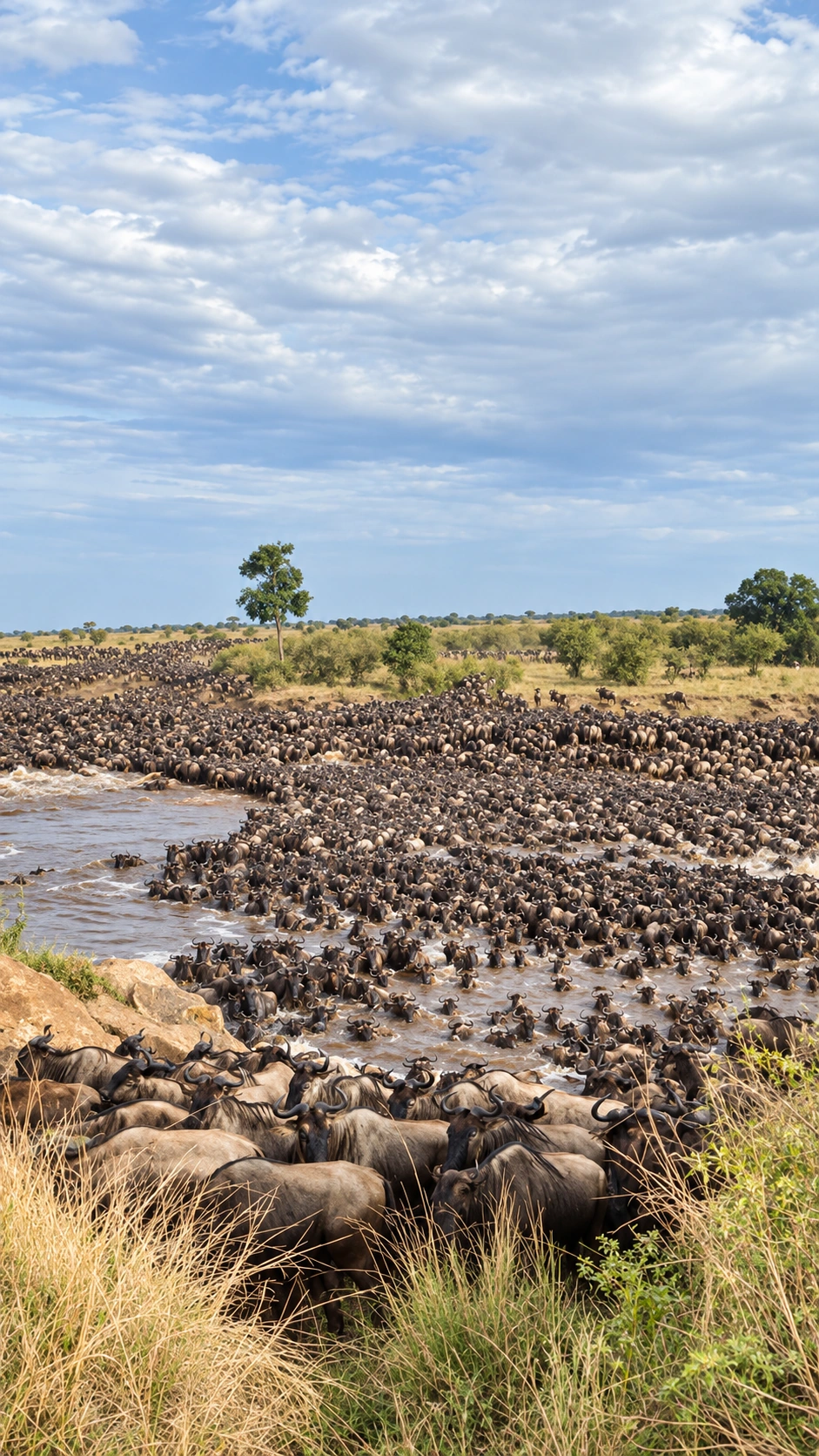
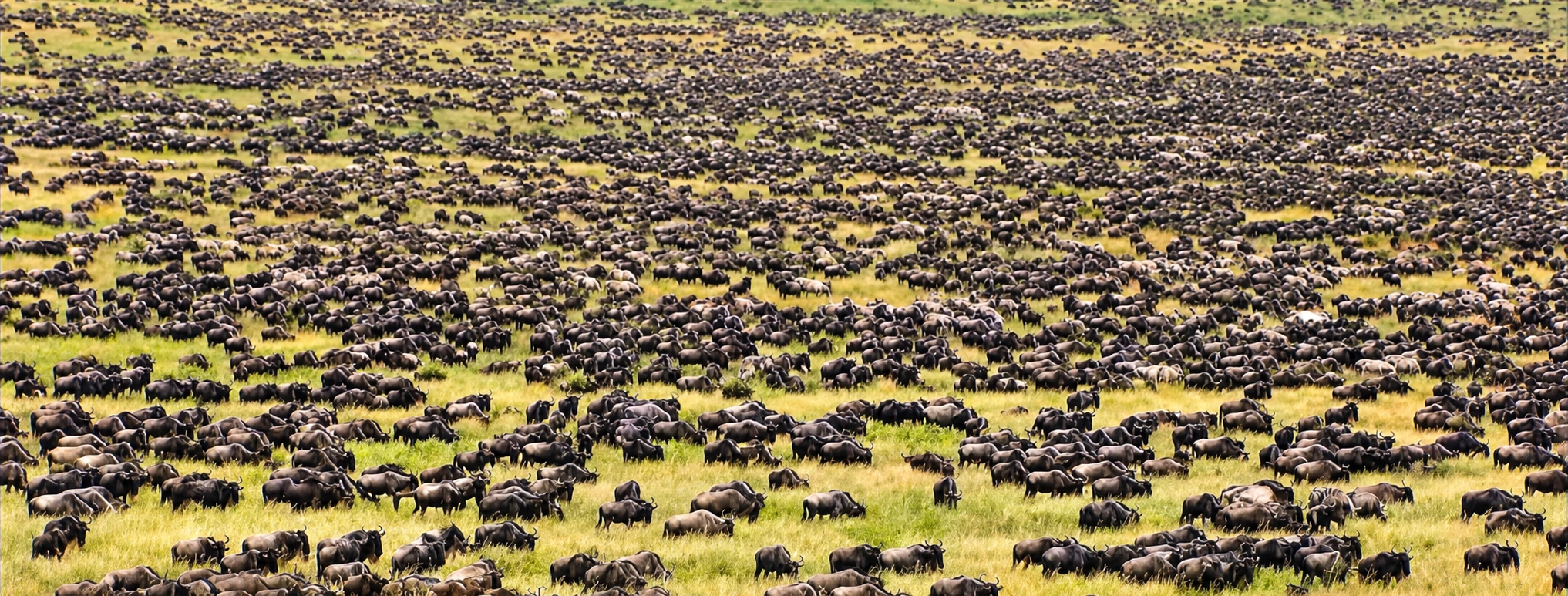
A line of wildebeest disappears into the distance. Another group changes direction. Somewhere beyond the horizon, rain has fallen. The Great Migration is an ecological system at work: animals finding food and water, raising their young and moving through a landscape that must remain connected for them to survive.
Serengeti National Park has been a UNESCO World Heritage Site since 1981. UNESCO recognises the exceptional migration of more than a million wildebeest and other grazing animals across the wider Tanzanian and Kenyan ecosystem. That recognition belongs to the whole living landscape, far beyond the few minutes of drama captured at a river.
Calling it a world wonder is a way of expressing its extraordinary scale and meaning. For the traveller, the deeper privilege is to spend time inside that movement: listening, watching and allowing something other than a human schedule to lead the day.
Rain writes the route.
The herds keep revising it.
The migration follows changing opportunities for grazing and water. The southern short-grass plains, enriched by volcanic soils, are a crucial seasonal habitat. When conditions change, the animals seek suitable feeding areas elsewhere in the ecosystem.
The broad annual pattern helps us plan a safari, but the herds don’t travel as one continuous procession. Groups separate, gather again and take different paths. That’s why we look at the season, recent movement and camp locations together.
We choose a region that gives your dates a good chance of reaching the herds, while leaving time for the Serengeti’s other wildlife. Your guide adapts each day to what’s happening on the ground.
Read the map.
Leave room for the rain.
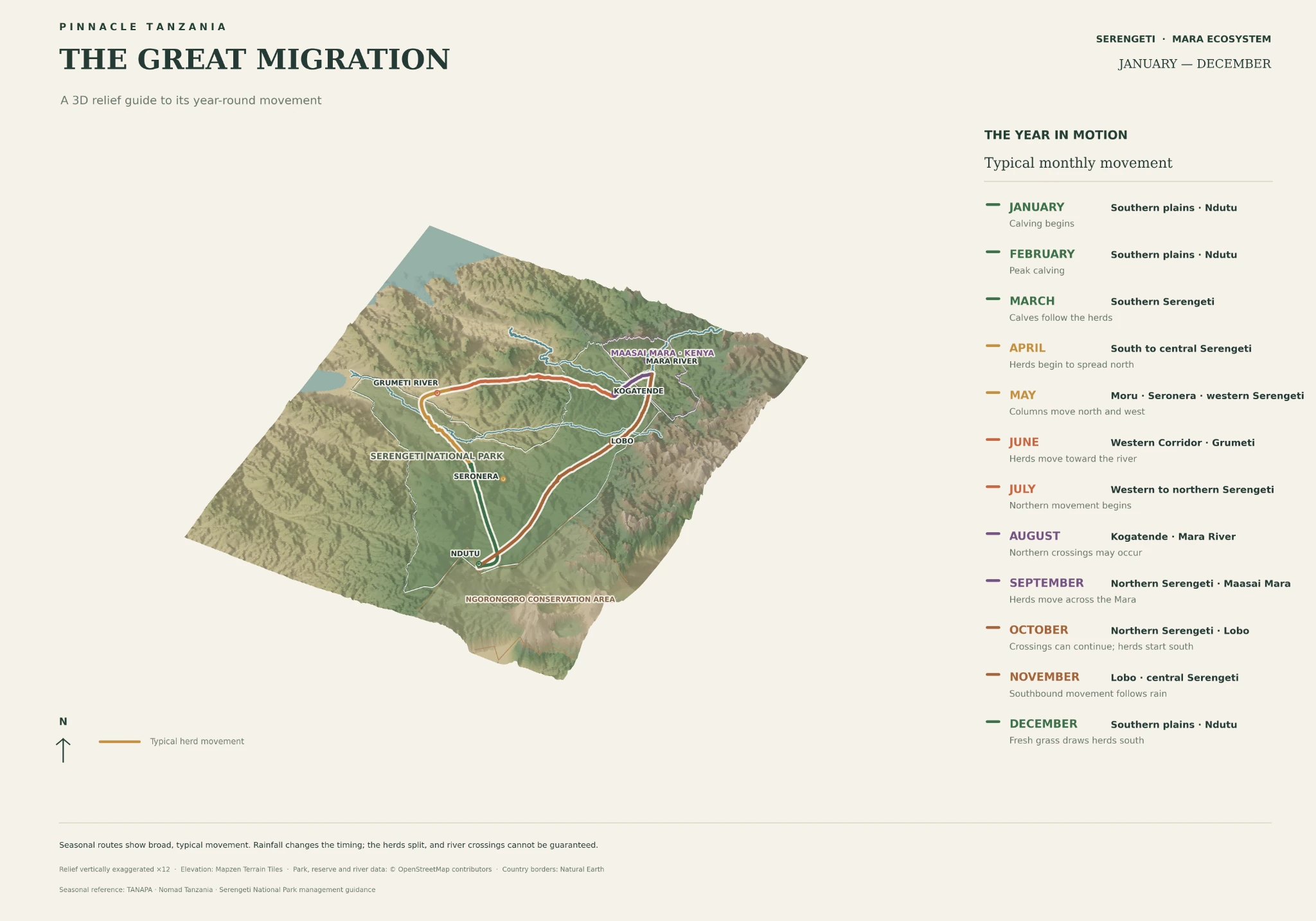
The map shows the broad seasonal movement of the herds across the Serengeti–Mara ecosystem. Use it to get your bearings, then let us help choose the region and camps for your dates. Rain and grazing can change the timing.
| Month | Region to discuss | Seasonal orientation |
|---|---|---|
| January | Southern short-grass plains · Ndutu | Fresh grazing; the calving chapter begins. |
| February | Southern plains · Ndutu | Often the peak calving window. |
| March | Southern plains and nearby areas | Young herds; rain can scatter groups. |
| April | Southern and eastern plains | Herds may remain south as conditions allow. |
| May | South toward central and western areas | Movement can build later in the month. |
| June | Western Corridor · Grumeti region | A broad westward movement as areas dry. |
| July | West toward northern Serengeti | Early arrivals north; many herds still moving. |
| August | Northern Serengeti · Maasai Mara | Herds spread across the northern ecosystem. |
| September | Northern Serengeti · Mara River region | Crossing opportunities depend on herd decisions. |
| October | Northern Serengeti and Mara areas | Movement continues, responding to local rain. |
| November | Northern areas toward the south | Short rains can draw herds southward. |
| December | Returning to the southern plains | Groups gather where fresh grazing develops. |
Herds can be spread across several regions, and the weather can change the timing. We check the fit of your dates and proposed camp locations before booking.
Calving season.
New life in a wild landscape.
On the southern plains around Ndutu, the migration has a different intensity. The scale is still enormous, but your attention can settle on the smallest details: young animals beside the herd, the pause before another movement, the relationship between open grassland and the life it supports.
January–March is the usual starting window for a calving-focused safari, with the peak often around February. Ndutu’s own seasonal account describes a wider southern stay from roughly mid-December into April, depending on rain and grazing. These are planning windows, not appointments for a birth.
Lions, cheetahs and other predators also live on these plains. Watching new life here can be moving, and sometimes difficult. Your guide helps you understand what you’re seeing, while births and hunts follow their own timing.
Our five-day Ndutu calving safari starts with Tarangire, then Ngorongoro, followed by two nights at Ndutu Heritage Camp and a final overnight in Arusha. Day 4 is a full Ndutu day; viewing around the arrival and return transfers depends on time. Extra Central Serengeti days can be added before the return to Arusha and quoted as an extension.
At the Mara River.
Make time to watch and wait.
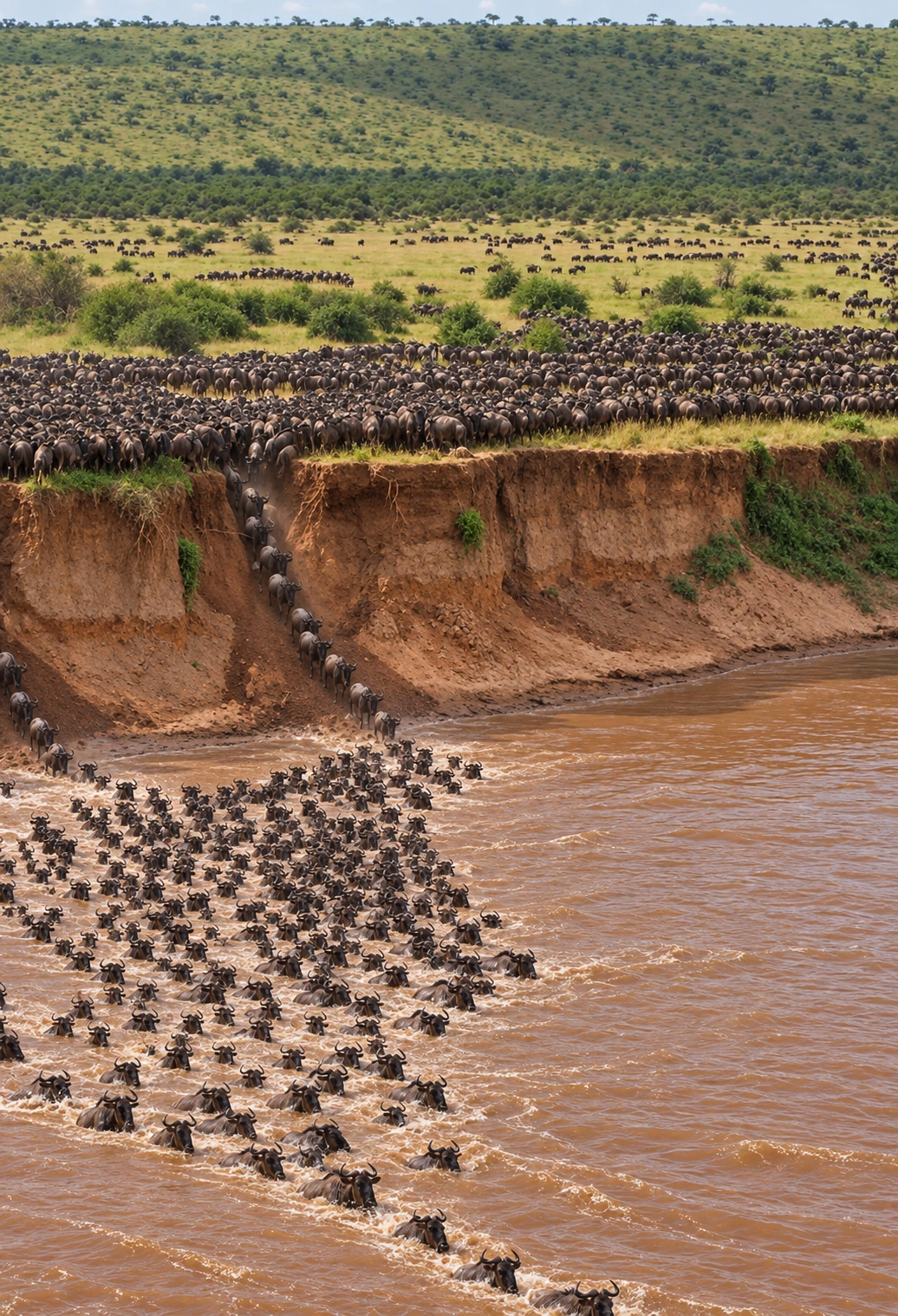
It is the image many travellers carry with them: a steep bank, a crowded edge and a sudden rush of animals into water. July–October is the usual starting window for planning northern Serengeti migration travel. The Mara River landscape extends through a wider ecosystem shared with Kenya, and the herds can cross and recross as grazing conditions change.
But an animal at the edge of a river has not agreed to cross it. A group can wait, turn away or move to another bend. A crossing can happen elsewhere while you are waiting. It can happen after you leave. Seeing thousands of wildebeest nearby and seeing them enter the water are different experiences.
Plan for the opportunity.
Let the animals own the moment.
Edited wildlife footage compresses the experience. A safari includes the waiting, the quiet, the changing light and the decisions about where to spend the next hour. A good guide reads the situation and manages your day; even an exceptional guide cannot command the river or the herd.
Our six-day Serengeti migration safari and seven-day river-crossing safari each include two northern nights, giving one dedicated full day there plus whatever viewing fits around the transfers. If a crossing is your central priority, we recommend discussing three or four northern nights in a revised quote. More time gives you more room to wait and explore; it does not create a guarantee.
Give the migration
space to remain wild.
The spectacle depends on connected habitats, grazing and water across a much larger landscape than any one viewpoint. Protecting that system matters more than collecting a dramatic photograph.
At river viewing areas, follow your guide and park staff. Keep to the permitted positions, leave the animals’ approaches clear and never ask a driver to push a herd toward the water. Your preferred camera angle does not take priority over wildlife movement.
Some of the finest migration memories may be quiet ones: the sound of hooves before you see the herd, an afternoon spent observing the plains, or a guide’s explanation that changes what you notice. Leave room for those moments when you choose the trip.
Your dates.
A route with a reason.
Start with what you want to experience, then choose the season and camp region. These are private starting itineraries. We confirm the named stays, transfers, access fees, meals and any extra nights in your complete quote.
Ndutu calving safari
5 days / 5 nightsTarangire Safari Lodge → Ngorongoro and Kuhama Camp → two nights at Ndutu Heritage Camp → an Arusha hotel night. One full Ndutu day; optional Central Serengeti extension.
See the calving itinerarySerengeti migration safari
6 days / 5 nightsA Serengeti-focused route with central stays and two nights in Northern Serengeti - Mara River. One full northern day, with additional northern nights available in a revised quote.
See the migration itineraryRiver-crossing safari
7 days / 6 nightsTarangire and Ngorongoro combined with central Serengeti and two northern nights. One full northern day. Ask about the separately quoted fly-out option.
See the river-crossing itineraryTell us which part of the story you want to see.
Share your travel dates, available days and wildlife priorities. We will propose a route that makes sense for the season, with the scope and price clear before you book.
Plan my migration safariQuestions before
your migration safari.
Is the Great Migration a scheduled event?
It is a recurring natural movement throughout the year, not a festival with a fixed start date. Rain, grass and water shape where the herds go.
Can a river crossing be guaranteed?
No. You can be in the right region and see large herds without witnessing a crossing. A guide, a camp booking or extra nights cannot make wild animals enter a river.
Do I need to go to Kenya for a Mara River safari?
Northern Tanzania has Mara River viewing areas in Serengeti National Park. Our northern itineraries explore that Tanzanian region. The wider migration ecosystem extends into Kenya, but a Kenya visit is not included in these Tanzania programmes.
Does calving season mean a guaranteed birth sighting?
No. The southern plains are a seasonal starting point for a calving-focused trip. Births, hunts and the location of the herds on a particular day remain unpredictable.
How should I use the map?
Use it to understand broad seasonal regions, then choose a camp and route for your dates. The map is illustrative, not a live tracker or a navigation map; the monthly table gives a readable planning guide.
Will Central Serengeti always have the migration?
Central Serengeti can form part of the herds’ movement, but a central camp does not guarantee access to the main herds in every month. Choose your base for the season and keep wider wildlife interests in the plan.